HSEO Issue Brief: Review of the Hartley/Roberts Report on Hawaiʻi’s Electricity Future

Note: This report, titled Hawaiʻi’s Electricity Future: Three Findings on Solar Reform, Enhanced Geothermal and the JERA LNG Proposal and published by the University of Hawaii Economic Research Association (UHERO), has been temporarily withdrawn by the paper’s lead author and will be reclassified as a working paper. This Issue Brief does not comment on the geothermal or jobs sections of the Hartley/Roberts report. 

The Hartley/Roberts report should not be relied upon as a basis for major electricity-system planning decisions for Oʻahu. Although the report presents a capacity-expansion analysis of Hawaiʻi’s electricity future, its conclusions are not supported by the level of reliability, land-use, emissions, transmission, distribution, operational, and community-feasibility analysis required for an isolated island grid. 

Hawaiʻi must accelerate clean energy deployment, including distributed solar and storage, responsibly sited utility-scale solar and storage, and energy efficiency, demand response, and other clean resources. However, the Hartley/Roberts report reaches broad conclusions that are not adequately supported by the analysis presented. In particular, the report overstates what capacity-expansion modeling can prove without corresponding resource adequacy, production cost, transmission, distribution, land use, interconnection, and system security analysis. 

I. Executive Summary

The report’s most serious flaws are: 

1. The land-use assumption is unrealistic. The report’s centerpiece assumption of installing more than 5,000 MW of utility-scale solar across Oʻahu is not a minor modeling assumption; it would represent a massive land-use transformation of the island. 

2. The reliability analysis is inadequate. The report relies on a limited set of sample days and does not fully test multi-day renewable droughts, storm conditions, generator outages, transmission contingencies, distribution constraints, or other emergency conditions that are central to island-grid reliability 

3. The counterfactual is flawed. The report appears to treat JERA LNG as an additive to HECO’s proposed Waiau Repower in key scenarios, rather than fully testing whether JERA could replace Waiau Repower, reduce or eliminate reliance on the Kahe and Waiau power plants, or accelerate retirement or allow fuel switching for older LSFO-burning units.

4. The report underplays the problem of continued reliance on HECO’s existing firm fleet. A “no new thermal” case that depends on aging, inefficient, LSFO-burning units is not necessarily cleaner, cheaper, or more reliable in practice. 

5. Major emissions claims are insufficiently supported. The report makes significant claims about emissions impacts without providing sufficient transparent dispatch, fuel, heat-rate, lifecycle-emissions, and retirement assumptions. 

6. The report overstates what wheeling and soft-cost reform can solve. A PUC wheeling decision will not, by itself, resolve landowner willingness, permitting, community opposition, interconnection studies, project financing, litigation risk, or utility-scale RFP design. 

7. The report does not adequately address distributed energy resources as a central alternative. A more equitable and resilient pathway should place greater emphasis on rooftop solar, parking canopy solar, distributed batteries, demand response, grid-interactive loads, community solar, virtual power plants, conservation, energy efficiency, and rate design. 

The report’s conclusions regarding “no new combined-cycle beyond Puʻuloa,” rejection of JERA LNG, and feasibility of a massive utility-scale solar buildout are not sufficiently supported by transparent assumptions and modeling, reliability studies, land-use analysis, dispatch data, and independent validation. 

II. Land Use: The Central Solar Assumption Is Deeply Flawed 

The Hartley/Roberts report’s centerpiece assumption of installing 5,243 MW of utility-scale solar on 31,500 acres on Oʻahu is deeply flawed and raises questions about the feasibility, realism, and validity of the analysis. Merely identifying land as “developable” does not make it socially, environmentally, culturally, or politically available for utility-scale energy development. 

Screened acreage is not the same as developable acreage. After landowner willingness, agricultural policy, cultural resources, habitat, drainage, slope, access roads, interconnection, substations, community acceptance, litigation risk, and permitting are accounted for, the usable acreage could be much lower. The Hartley/Roberts report appears to treat the hardest constraint in Hawaiʻi as though it were a secondary implementation issue. 

Land use is not a minor implementation detail in Hawaiʻi; it is often the central constraint. Oʻahu has limited land, competing needs for agriculture, housing, conservation, cultural resources, watershed protection, and community priorities, and a long history of uneven siting burdens. Any serious clean energy pathway needs to account for those realities. 

The cancelled 15 MW Paeahu Solar project in South Maui illustrates that even much smaller solar-plus-storage projects can face serious siting, community, litigation, and implementation risks. Paeahu Solar was proposed with a 60 MWh battery system on approximately 200 acres leased from ʻUlupalakua Ranch and was expected to serve approximately 6,900 Maui households, but Hawaiian Electric and Innergex ultimately cancelled the project after lengthy delays due to legal challenges and sustained opposition from some residents. 

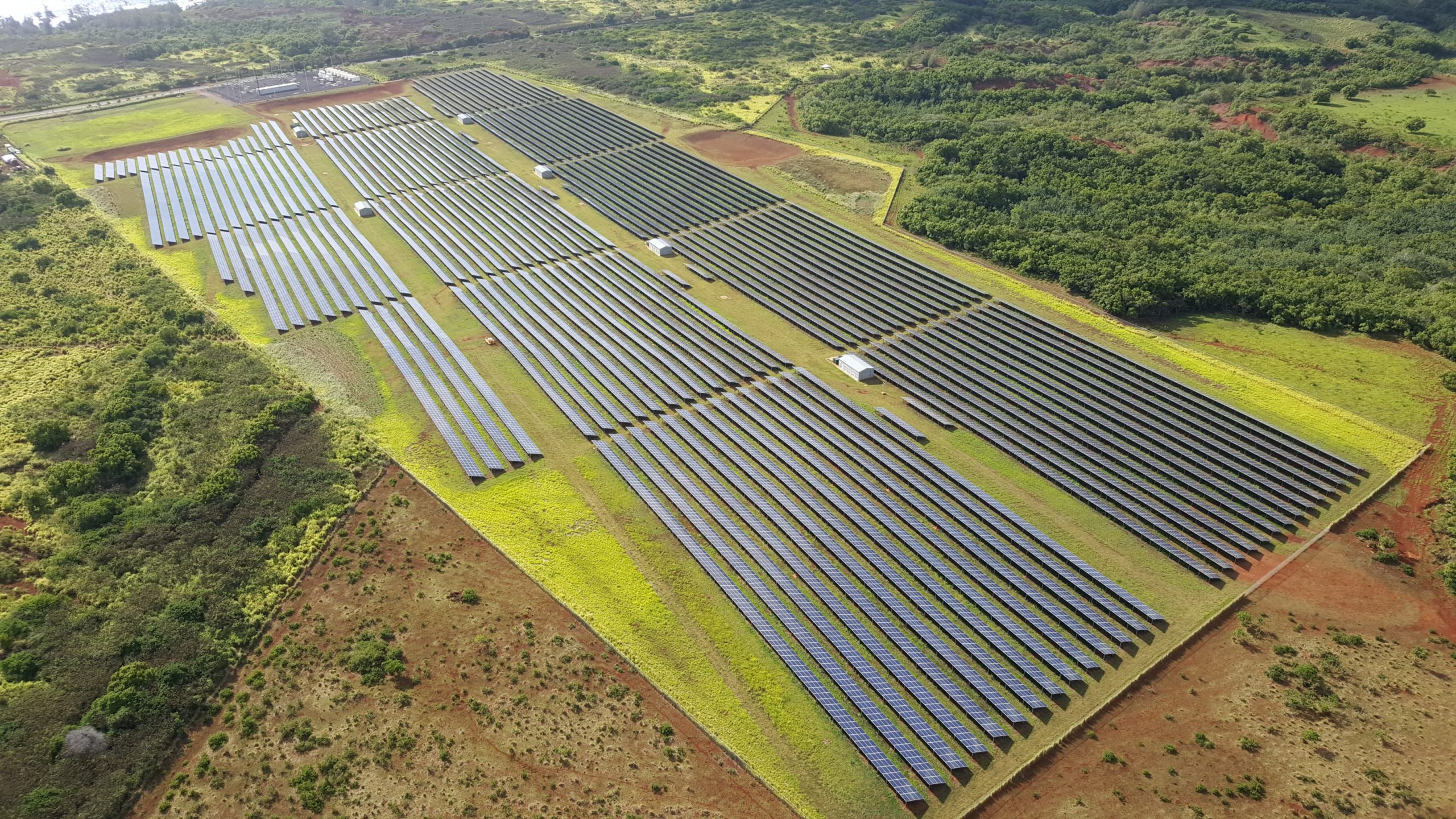
Community opposition is not unusual for large land-intensive renewable energy projects in Hawaiʻi, particularly where projects affect open space, agricultural lands, cultural resources, view planes, drainage, wildlife concerns, or communities that already feel overburdened by infrastructure siting. The proposal discussed in the Hartley/Roberts report would require utility-scale solar development on a vastly larger scale — more than 5,000 MW across 31,500 acres on Oʻahu — across essentially every area the authors identify as suitable for solar parcels, including Waiʻanae, the Central Plain, ʻEwa, windward Oʻahu, and other parts of the island that appear, based on the report’s maps, to include certain beach parks, stream beds, and densely forested areas deep in the island’s valleys. 

Consider that Oʻahu currently has about 357 MW of utility-scale solar compared with 2,984 MW of total installed capacity. Scaling to more than 5,000 MW of utility-scale solar would represent an enormous land-use transformation, not simply a technical substitution for fossil generation. Hawaiʻi’s energy strategy recognizes and embraces the essential role for more solar, but it must transparently address the land-intensive nature of utility-scale solar, especially on Oʻahu. 

The Hartley/Roberts report should also clarify whether the acreage calculation is based on MWdc or MWac. DC:AC ratio, fixed-tilt versus tracking design, capacity density, MWh output per acre, and interconnection capacity all materially affect the land requirement. A mismatch between MWac modeling and MWdc land-density assumptions could materially understate acreage. 

III. Flawed Assumptions and Methods 

A. Capacity expansion is not a substitute for integrated resource planning. 

The Hartley/Roberts report overstates what its modeling can prove. Capacity-expansion modeling can identify potentially lower-cost portfolios under a defined set of assumptions. It cannot, standing alone, prove that a high-renewable island grid can operate reliably under real-world conditions. 

For Oʻahu, the relevant question is not merely which resource mix minimizes modeled system cost. The question is whether the portfolio can maintain service during multi-day cloudy and low-wind periods, generator outages, transmission failures, distribution constraints, storm recovery, and emergency conditions. 

Oʻahu cannot lean on neighboring balancing areas. Frequency response, contingency response, ramping, minimum generation, grid-forming capability, black start, storm recovery, and multi-day low-renewable events matter more than they do in large, interconnected electricity systems such as those on the continent. 

The Hartley/Roberts reliability analysis is too narrow. It relies on a limited set of sample days and does not fully test week-long renewable droughts, storm conditions, fuel-supply disruptions, generator outages, or major transmission contingencies. That limitation goes directly to whether the report’s “no new combined-cycle beyond Puʻuloa” conclusion is valid. 

B. The report does not adequately evaluate reliability and resilience. 

Another flaw is that reliability and resilience are not adequately evaluated in the Hartley/Roberts analysis. Oʻahu absolutely needs to accelerate clean energy deployment, including stronger policy and rate incentives for distributed solar, storage, demand response, and responsibly sited utility-scale solar. But the grid also needs resources that can maintain service during prolonged cloudy weather, storms, transmission or distribution outages, and other emergency conditions. 

A clean energy transition that relies heavily on variable solar generation must still address the need for firm, flexible, and resilient resources that can support the system when solar output is low for extended periods. The Hartley/Roberts report does not sufficiently address the need for firm, flexible capacity during extended low-renewable periods, including periods when solar and wind output may be low for multiple consecutive days. Prior technical work by General Electric, HNEI, Hawaiian Electric, and others has emphasized that these conditions are material to Hawaiʻi grid planning. 

The report does not fully test multi-day climate stress, transmission constraints, local siting constraints, or detailed distribution hosting capacity. For Oʻahu, those are not academic sensitivities. They are core planning requirements. 

C. The report uses the wrong counterfactual. 

The Hartley/Roberts report appears to treat JERA LNG as an added resource layered on top of Waiau Repower in key scenarios. That is not the intent of the JERA plan. Relevant scenarios would test whether JERA’s 500 MW high-efficiency power plant fully replaces Waiau Repower, reduces reliance on or eliminates Kahe and Waiau power plants entirely, supports retirement of older LSFO units, and changes the timing and cost of firm-resource needs identified in Hawaiian Electric’s Integrated Grid Plan. 

If the “no new combined-cycle” case depends on continued availability of old, inefficient thermal units with known maintenance, outage, minimum-load, and reliability constraints, then it may understate both cost and reliability risk. A proper integrated resource plan comparison should clearly show what units retire, what units remain available, what new resources are added, and how each portfolio meets reliability criteria. 

This is a fundamental flaw. The Hartley/Roberts report strongly criticizes LNG as unnecessary, but its alternative may depend on preserving the existing LSFO fleet as a reliability backstop. That is not a clean or risk-free counterfactual. 

D. The report underplays continued reliance on LSFO and HECO’s aging firm fleet. 

The Hartley/Roberts “no new combined-cycle” case is not the same thing as a no-fossil or low-risk firm-capacity pathway. It appears to rely on HECO’s existing firm units remaining available in the background while solar and batteries expand. That matters because existing LSFO-burning units are aging, relatively inefficient, emissions-intensive, and subject to maintenance, outage, minimum-load, and operational constraints. 

A planning analysis should not treat existing thermal capacity as a free or uncomplicated reliability bridge. It should disclose, by unit, the assumed retirement dates, availability, outage rates, heat rates, minimum generation levels, ramp rates, maintenance costs, fuel costs, emissions rates, and operating constraints. It should also test whether continued reliance on those units is consistent with reliability, emissions, cost, and statutory clean-energy objectives. 

The Hartley/Roberts critique of LNG is incomplete unless it also confronts the weaknesses of the alternative on which it relies: continued use of LSFO-fired generation and existing firm resources. An outcome that avoids new thermal investment but keeps old LSFO units available for reliability may look cheaper in a model while shifting risk to reliability, maintenance, emissions, and emergency operations. 

E. The report relies on incorrect assumptions about JERA’s cost and payback structure. 

The Hartley/Roberts report appears to rely on incorrect or insufficiently documented assumptions regarding JERA’s cost and payback structure. Based on information currently available to HSEO, the JERA capital cost is understood to be approximately $2 billion with the power plant and gas import facilities included, not $2.4 billion plus additional LNG import facilities. The Hartley/Roberts report should clearly document the cost basis it used. If the report assumes $2.4 billion plus separate LNG import facilities, that could represent roughly a 30 percent overestimation and would materially bias the result against JERA. 

The JERA 500 MW + LNG plan also should not be characterized as a 20-year payback for the entire infrastructure. The LNG-associated infrastructure appears to have a less-than-five-year payback, while the 20-year horizon applies to the majority of the plan — the 500 MW high-efficiency power plant — that could restore long-term system reliability to Oʻahu and may be capable of running on biodiesel, renewable natural gas, or hydrogen to meet Hawaiʻi’s RPS law. 

The Hartley/Roberts report should not make definitive claims about JERA’s economics unless the capital-cost stack, ownership structure, cost recovery, fuel contract, payback assumptions, and fuel-flexibility assumptions are clearly disclosed and tested. 

F. Outdated Solar Procurement Data May Undermine the Report’s Cost Conclusions 

The report’s total system cost results are highly sensitive to assumed solar and battery costs, which is a critical limitation given the central role those assumptions play in the analysis. The report itself states that, at its baseline cost basis, total 2027–2050 system cost is approximately $24.7 billion, but rises to $28.0 billion if solar and battery costs are 50 percent higher and $28.8 billion if they are 70 percent higher. The report further states that each additional 10 percentage points of solar cost adds roughly $700 million to total system cost between the baseline and 1.5x multiplier, and roughly $400 million per 10 percentage points above that. In other words, the report’s headline least-cost conclusions are not a minor function of solar and battery pricing assumptions; they are materially dependent on them. The report’s own framing that solar and battery procurement reform is a roughly $3.4 billion lever reinforces that the modeled results are highly exposed to whether the assumed solar and storage cost trajectory is realistic for Oʻahu. 

This sensitivity is especially concerning because the report appears to rely, at least in part, on stale cost evidence from Hawaiian Electric’s Stage 1 RFP projects rather than treating more recent Stage 3 procurement results as the operative benchmark for current market conditions. The report acknowledges that the $0.08 to $0.12/kWh pricing range reflects Stage 1 awards from 2018–2019, while Stage 3 Oʻahu solar-plus-storage awards approved in 2024–2025 came in at approximately $0.21 to $0.23/kWh for predominantly four-hour configurations—roughly two to nearly three times the Stage 1 range. Although the report characterizes this escalation as evidence of soft-cost inflation rather than a change in underlying fundamentals, the practical effect is that current delivered project costs in Hawaiʻi are far above the low-cost assumptions that drive the report’s modeled savings. A least-cost plan for Oʻahu should not treat outdated Stage 1 pricing as representative of deployable near-term resources without a more rigorous demonstration that procurement, interconnection, permitting, financing, and siting reforms can actually bring Stage 3-era costs down to the assumed levels within the modeled timeframe. 

G. Limited Land-Cost Evidence Does Not Support Systemwide Conclusions 

The report’s reliance on a small number of University of Hawaiʻi solar RFPs and confidential lease agreements is not a sufficient basis for concluding that land costs are immaterial to utility-scale solar deployment on Oʻahu. Those examples may show that certain public or institutionally controlled parcels can be leased at competitive ground-rent rates, but they do not establish that similar terms would be available across the thousands of acres and hundreds of privately and publicly controlled parcels needed to support the report’s modeled utility-scale buildout. Ground rent on a few selected parcels is not the same as the full marginal cost of acquiring, permitting, interconnecting, and socially licensing tens of thousands of acres of solar development. 

This distinction matters because the report’s own land-use discussion acknowledges that practical constraints include landowner willingness, community acceptance, cultural and environmental review, agricultural-land policy, transmission proximity, distribution-level hosting capacity, and litigation risk. Those constraints can affect project cost even if nominal ground rent appears low. A credible land-cost analysis would need to evaluate parcel-specific ownership, lease terms, agricultural opportunity costs, community-benefit or mitigation costs, interconnection and transmission costs, permitting risk, and the likelihood that landowners will demand higher compensation as the buildout approaches the limits of available developable land. A few UH RFPs do not provide that systemwide evidence. 

H. The report overstates wheeling as a solution to solar costs. 

The Hartley/Roberts report implies that retail wheeling could address much of Hawaiʻi’s solar cost premium. That claim is weak. A PUC wheeling decision would not, by itself, solve permitting delays, landowner willingness, community opposition, HECO interconnection studies, utility-scale RFP design, project financing, customer-acquisition costs, litigation risk, or site control. 

Many of the causes the report identifies for high solar costs occur outside the PUC wheeling docket. The report therefore appears to assign too much causal weight to wheeling while underweighting the actual institutional, land-use, permitting, interconnection, and community-acceptance barriers that delay or prevent projects. 

IV. Lack of Supporting Data and Analysis for Major Claims 

A. The emissions claims are not adequately supported. 

The Hartley/Roberts report makes major emissions claims without sufficient transparent support. It claims JERA LNG would increase cumulative power-sector emissions by about 34 percent, displace about 430 MW of solar and 6,500 MWh of battery storage, and reduce 2050 renewable generation from 87 percent to 75 percent. The report should disclose the calculations and assumptions in far greater detail to demonstrate that such consequential conclusions are supported by fact. 

The report should account for the wide range of lifecycle emissions associated with biofuels. Biofuels are not uniformly low-carbon simply because they are labeled “renewable”; emissions vary significantly based on feedstock, fertilizer use, land-use change, processing energy, transportation, methane and nitrous oxide emissions, and whether the fuel is waste-derived or crop-based. 

This matters because the report’s conclusions about future thermal resources may depend on assumed use of renewable fuels or biodiesel. For example, a waste-oil-based fuel could have very different lifecycle emissions than a crop-based fuel imported to Hawaiʻi. Any finding that continued operation of firm thermal units on renewable fuel is compatible with deep decarbonization should therefore be supported by fuel-specific lifecycle emissions assumptions, including feedstock source, carbon intensity, supply chain, land-use-change treatment, and high- and low-emissions sensitivity cases. 

At minimum, the report should provide: 

• annual dispatch by generator, fuel, and scenario; 

• heat rates by unit and year; 

• cumulative CO₂ and CO₂e emissions by scenario; 

• lifecycle emissions for LNG, LSFO, biodiesel, renewable diesel, hydrogen, biomass, and H-Power

Note: The report falsely reports that H-power is “zero carbon baseload.” In 2023, H-Power had 378,136 tons of CO2 equivalent emissions according to EPA eGrid data. 

• methane leakage assumptions; 

• upstream production and shipping emissions; liquefaction and regasification emissions; 

• post-2045 fuel assumptions; 

• assumed retirement dates for Kahe, Waiau, and other firm units; 

• the dispatch volumes driving the 34 percent emissions claim. 

Without that information, the emissions conclusion should be treated as unsupported. The report should not compare LNG against a modeled solar-heavy counterfactual while ignoring whether LNG could replace older LSFO resources, enable earlier retirement, or reduce dispatch from more polluting units. 

B. LNG should not be evaluated only as a fuel switch against static LSFO generation. 

LNG should not be evaluated only as a fuel switch against static LSFO generation. It should be evaluated as part of a portfolio that may retire older oil units such as Waiau and Kahe, reduce or increase fossil dispatch, interact with renewable buildout, and potentially support broader energy-system uses. 

If LNG is modeled as additive to existing firm resources and subject to take-or-pay dispatch, it will predictably look worse. But that does not answer the more relevant planning question: whether a modern, high-efficiency, fuel-flexible plant with LNG infrastructure could replace or reduce reliance on older, dirtier, less reliable LSFO units while supporting a higher-DER, more resilient grid. 

C. Solar and battery lifecycle costs need more scrutiny. 

The Hartley/Roberts report relies heavily on solar plus storage, but it does not clearly address solar degradation, inverter replacement, battery degradation, battery augmentation, battery replacement, usable versus nameplate capacity, or end-of-life costs. 

That matters because a portfolio with thousands of MW of solar and thousands of MWh of batteries through 2050 will have major lifecycle replacement and augmentation needs. If batteries are modeled as remaining fully available without degradation or replacement costs, the model may understate the lifecycle cost of the solar-plus-storage pathway relative to firm generation alternatives. 

V. The Report Underweights DER and More Equitable Alternatives 

The Hartley/Roberts report underdevelops a key solution under review by HSEO to expand distributed energy resources, as highlighted in Governor Green’s Executive Order 25-01. The state is looking for solutions that are more equitable, reliable, resilient, and acceptable to affected communities. 

A more credible clean-energy pathway for Oʻahu should place greater emphasis on: 

• conservation 

• energy efficiency 

• advanced dynamic rate design 

• rooftop solar 

• parking canopy solar 

• distributed batteries 

• grid-interactive water heating 

• managed EV charging 

• demand response 

• virtual power plants 

• community solar 

• public facility solar and storage 

• resilience hubs 

• responsible utility-scale solar outside of tsunami zones and where land-use conflicts are manageable. 

The report’s visual and modeling emphasis on very large amounts of land-based utility-scale solar risks presents a pathway that is politically, culturally, and physically unrealistic on Oʻahu. 

VI. Questions for Further Review

1. Is the 31,500-acre estimate based on MWac or MWdc? 

2. What DC:AC ratio was assumed for utility-scale solar? 

3. What capacity density was used for fixed-tilt versus tracking systems? 

4. How much land would be required if Oʻahu-specific MWdc-per-acre assumptions are used? 

5. How much of the screened acreage is actually developable after landowner willingness, cultural resources, habitat, agricultural policy, slope, drainage, access roads, interconnection, permitting, and litigation risk? 

6. How many individual parcels would be needed to reach 5,243 MW of utility-scale solar? 

7. How many separate land leases, permits, community processes, and interconnection studies would that require? 

8. How much of the mapped acreage overlaps with gulches, stream corridors, steep slopes, high ridges, drainage areas, agricultural lands, or culturally sensitive areas? 

9. How would the results change if available utility-scale solar land were reduced by 25 percent, 50 percent, or 75 percent? 

10. How would the preferred portfolio change with much higher reliance on rooftop solar, parking canopy solar, distributed storage, and VPPs

Reliability and resilience 

11. Why are 13 sample days from 2007–2008 sufficient for Oʻahu reliability planning? 

12. Has the portfolio been tested against a week-long low-solar/low-wind event? 

13. Has the portfolio been tested against Kona lows, storm conditions, wildfire events, fuel-supply disruptions, or simultaneous generator/transmission contingencies? 

14. What probabilistic resource adequacy standard was applied? 

15. What are the LOLE, EUE, and ELCC assumptions? 

16. What forced-outage rates were assumed for existing thermal units? 

17. Does the model include N-1 transmission contingency performance? 

18. Does the model include black start, grid-forming inverters, fault current, voltage support, inertia or synthetic inertia, and fast frequency response? 

19. What storage durations are assumed, and are batteries modeled as nameplate or usable capacity? 

Existing firm fleet and LSFO reliance 

20. Which Kahe and Waiau units remain online in each scenario? 

21. What retirement dates are assumed for Kahe, Waiau, CIP, and other firm resources? 

22. How much LSFO is burned each year in each scenario? 

23. What minimum generation constraints are assumed for the existing firm fleet? 

24. What maintenance and outage risks are assumed for aging LSFO-fired units? 

25. How would results change if Kahe retired earlier? 

26. How would results change if older Waiau units retired earlier? 

27. How would results change if existing firm units had lower availability or higher maintenance costs? 

JERA and Waiau counterfactuals 

28. What happens if JERA replaces Waiau Repower rather than being added to it? 

29. What happens if JERA enables earlier retirement of Kahe and Waiau units? 

30. What happens if JERA is modeled as a fuel-flexible power plant capable of biodiesel, renewable natural gas, or hydrogen operation? 

31. What capital cost did the Hartley/Roberts report assume for the JERA plant? 

32. Did the report assume $2.4 billion plus additional LNG import facilities, or approximately $2 billion including the plant and import facilities? 

33. What payback assumption was used for LNG-associated infrastructure? 

34. What payback assumption was used for the power plant portion? 

35. How would correcting the JERA capital-cost assumption affect the system-cost comparison? 

Emissions and lifecycle analysis 

36. What dispatch volumes drive the 34 percent cumulative emissions increase claim? 

37. Are the emissions estimates power-sector CO₂ only, or lifecycle CO₂e? 

38. How are methane leakage, liquefaction, regasification, and shipping emissions modeled for LNG? 

39. How are upstream, refining, shipping, and combustion emissions modeled for LSFO? 

40. How are biodiesel, renewable diesel, hydrogen, biomass, and H-Power emissions modeled? 

41. What post-2045 fuels are assumed for each firm resource? 

42. Does the report count H-Power as renewable or zero-carbon, and if so, why? 

43. How would emissions change if LNG enabled earlier LSFO unit retirements?  

Customer bills, affordability, and rate impacts 

44. What are the estimated residential, commercial, industrial, and government-customer bill impacts under each scenario? 

45. Are cost impacts evaluated on a total-system-cost basis, revenue-requirement basis, customer-rate basis, or all three? 

46. How are stranded costs, accelerated retirements, fuel-price risk, and new transmission and distribution investments reflected in customer bills? 

47. How are low- and moderate-income customers affected under each modeled pathway? 

48. Does the report evaluate whether the solar-heavy pathway shifts costs between customers with DER access and customers without DER access? 

Cost, wheeling, and data transparency 

49. Is the 20 percent Hawaiʻi premium applied uniformly across all technologies? 

50. What Oʻahu-specific evidence supports the assumed utility-scale solar premium? 

51. What exact reforms are assumed to reduce solar costs? 

52. Which of those reforms are actually within the PUC wheeling docket? 

53. What wheeling compensation structure and project-size assumptions are used? 

54. Were T&D upgrades quantified, and if so, how much do they cost by scenario? 

55. When will the full model files, inputs, assumptions, and dispatch outputs be released? 

56. Can reviewers verify scenario tags, forced builds, retirements, fuel constraints, emissions factors, and output tables? 

VII. Conclusion 

The Hartley/Roberts report is not sufficiently reliable to support its strongest conclusions. It uses a simplified modeling framework to make broad claims about Oʻahu’s electricity future while failing to fully account for land-use constraints, island-grid reliability, continued dependence on LSFO-fired units, transmission and distribution deliverability, community acceptance, lifecycle emissions, and customer-bill impacts. 

The report’s most problematic conclusion is that Oʻahu can avoid new firm thermal capacity beyond Puʻuloa while relying on a massive buildout of utility-scale solar and batteries. That conclusion may be true only within the model’s assumptions. It is not proven under real-world Oʻahu conditions unless validated through resource adequacy, production cost, transmission, distribution, system security, land use, and community feasibility analysis. 

HSEO concludes that Hawaiʻi is better served by accelerating clean energy deployment consistent with current policies, executive orders and strategies, not through an unrealistic land-intensive pathway or an under tested reliability framework as proposed in the Hartley-Roberts report. A serious plan should prioritize DER, conservation, efficiency, rooftop and parking canopy solar, distributed storage, demand response, responsible utility-scale solar, and firm low-carbon resources that reduce dependence on aging LSFO units while maintaining reliability during the conditions that matter most. 
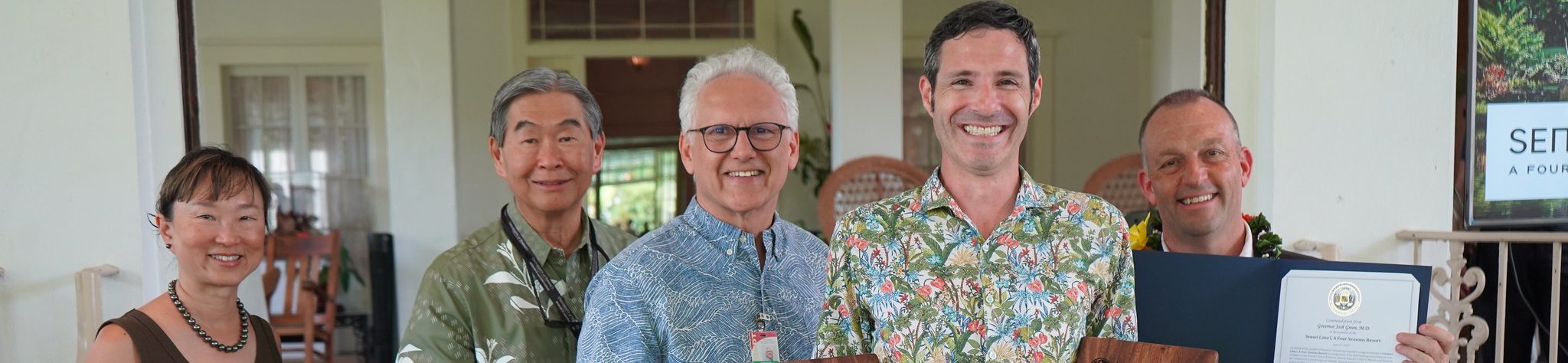
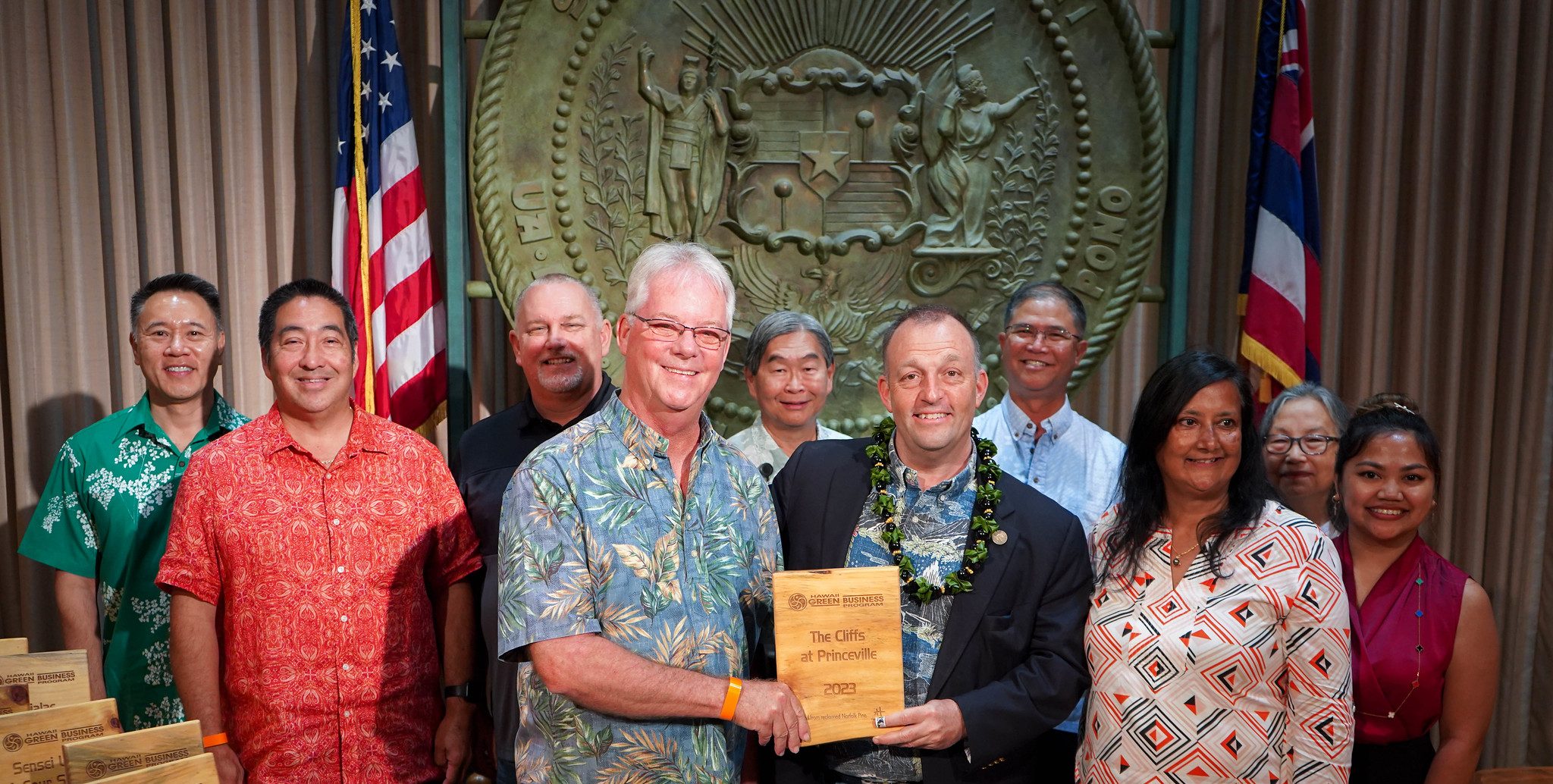
2024/2025 HAWAI‘I GREEN BUSINESS AWARDS PROGRAM HONORS HAWAI‘I BUSINESSES AND EVENTS FOR SUSTAINABILITY PRACTICES 

HONOLULU —The Hawai‘i Green Business Program (HGBP) recognized 45 Hawai‘i businesses and events today for their commitment to energy and water efficiency, waste reduction, pollution prevention and community involvement, as well as cultural and natural resource preservation. 

The 45 awardees representing six islands were recognized during the annual HGBP awards ceremony at historical Washington Place. Hosted by the Hawai‘i State Energy Office, the Honolulu Board of Water Supply and Hawaiʻi Energy, the awards program showcases the businesses advancing Hawaiʻi’s clean energy and sustainability goals, emphasizing energy efficiency as a key solution in accelerating Hawaiʻi’s move to renewable energy. 

Governor Josh Green, M.D., praised awardees for their commitment to sustain the ecological, cultural and economic health of Hawaiʻi, heralding lawmakers for the 2025 passage of the nation’s first climate impact fee to fund environmental stewardship and address the impacts of climate change. 

Green said, “At a time when environmental protections are being repealed at the federal level, Hawaiʻi will not forfeit its commitment to a more resilient, clean economy. The businesses and organizations we recognize today honor a statewide commitment to malama ʻāina — to steward our precious natural resources for future generations.”   

“Simply put,” said Hawai’i Chief Energy Officer Mark Glick, “using less energy means we need to generate less. These 45 businesses are among the best applying efficiency to our commercial building stock and energy efficient business practices make a profound difference.” 

Newly appointed state director of energy efficiency and renewable energy Monique Zanfes concluded, “Many of the businesses in this room rely on Hawai‘i’s natural resources not just for operations, but as the foundation of what draws people here. Protecting these resources isn’t just the right thing to do — it’s essential to the long-term viability and health of Hawai‘i. I thank them for leading by example.” 

The honorees of this year’s Hawai‘i Green Business Program Awards are:

Green Hotels, Resorts, Venue and Office Awardees:

  • Ala Moana Hotel by Mantra
  • Halekulani
  • Halepuna Waikiki
  • Hokulani, a Hilton Grand Vacations Club
  • The Kahala Hotel & Resort
  • Marriott’s Ko Olina Beach Club
  • Prince Waikiki
  • Kings’ Land, a Hilton Grand Vacations Club
  • Maui Bay Villas, a Hilton Grand Vacations Club
  • The Cliffs at Princeville
  • Four Seasons Resort O‘ahu at Ko Olina
  • Four Seasons Resort Maui at Wailea
  • Four Seasons Resort Lānaʻi
  • Sensei Lānaʻi, A Four Seasons Resort
  • Hawai‘i Convention Center
  • Waialae Country Club
  • Honeywell International/Smart Energy
  • Coradorables Sustainable Corporation

Green Event Awardees:

  • 2024 Hawai‘i Library Association/HASL HLA Conference
  • 2024 Sony Open
  • Artist Waltz
  • Green Business Engagement National Network – 7th National GBENN Summit
  • Sentry 2024 Golf Tournament of Champions / PGA Tour

Entry Level Program Awardees:

  • Coconut Ave
  • Drip Studio
  • The Fresh Shave
  • Hoku Foods Natural Market
  • Kilauea Bakery
  • Lady Elaine
  • Leong’s Road House
  • Little Plum
  • Uncle Paul’s Corner Store
  • Maui Juice Co.
  • Morning Glass Coffee
  • Pele’s Kitchen
  • Pu‘u O Hōkū Ranch
  • Sweet Cane Café
  • The Locavore Store
  • Oko‘a Farms Produce
  • Hanalei Spirits Distillery
  • Kaua‘i Island Brewing Co.
  • Kona Brewing Company
  • Lanikai Brewing Co.
  • Maui Brewing Company
  • Waikulu Distillery

For further information please visit Hawaii Green Business Program.

In one year, the energy efficiency measures of the above businesses resulted in 38.8 million gallons of water saved, 6.5 million kWh of electricity saved, 22.7 tons of green waste diverted, 12,372 tons of waste recycled,119,110 therms (1 therm = 100,000 BTUs) of gas saved, 6,725 metric tons of CO2 equivalent for electricity kWh reduced and 945 metric tons of CO2 equivalent for gas reduced. 

THE 2024/2025 Green Business Awards is livestreamed on the HSEO FB page at Hawaiʻi State Energy Office | Facebook  Press kits for 2024/2025 awardees can be found at Hawaiʻi Green Business Program. 

You can find the images by clicking here: 6.27.25 Hawaii Green Business Awards | Flickr

HAWAIʻI STATE ENERGY OFFICE NAMED REGIONAL PARTNER FOR ENERGY TECHNOLOGY INNOVATION PARTNERSHIP PROGRAM (ETIPP)

HONOLULU—The National Renewable Energy Laboratory (NREL) has named the Hawaiʻi State Energy Office (HSEO) as the ETIPP Regional Partner for Hawaiʻi and the Pacific Territories under the direction of Chief Energy Officer Mark B. Glick.

ETIPP is open to communities and organizations that are experiencing energy resilience challenges due to their remote geography, aging infrastructure and exposure to harsh weather conditions, among other considerations. In Hawaiʻi and the Pacific region, ETIPP has supported energy resilience projects at the University of Hawaiʻi, Guam, Hauʻula, Honolulu, Kahikinui, Kauai, Molokai, Upcountry Maui and Waianae.

In its fifth cohort, the program offers two tracks for technical assistance: strategic energy planning or technical deep dives. Communities in the early stages of planning energy system improvements will spend four to eight months in ETIPP developing a strategic energy plan that clearly defines their energy goals and objectives. Those joining ETIPP with an existing energy plan or well-defined energy project will embark on a 12- to 24-month process to explore the technical dimensions of specific energy solutions.

“ETIPP programs assist Hawai’i and Pacific region communities in building actionable energy plans to increase grid stability, replace aging infrastructure and address connectivity constraints,” says Hawaiʻiʻs Chief Energy Officer Mark B. Glick. “Solutions developed in tandem with local communities build trust in the energy planning process, augmenting community-based ingenuity with high-level technical expertise.”

How the program works:

Strategic Energy Planning is a 4- to 8-month effort that supports communities in developing actionable goals for their energy resilience planning. HSEO and supporting lab technical experts will work with communities to guide the planning effort, resulting in a completed strategic energy plan, which includes a high-level energy assessment and baseline, individualized community goals, and a unique community action plan that defines energy resilience and affordability in the near-, mid-, and long terms.

The Deep Dive technical assistance track is for communities with an existing and current energy plan (developed within the last 5 years) or specific project that fits within the scope and purview of ETIPP. The Deep Dive track can be between 12 to 24 months and will result in a thorough analysis led by national lab technical subject matter experts.

Examples of technical assistance available through the ETIPP Deep Dive track include:

  • Analyzing the feasibility and impacts of deploying local energy technologies that can provide resilience, reliability, and affordability
  • Producing guidance for energy policy and decision-making
  • Assessing leading-edge technologies and innovative energy system improvements.

ETIPP is currently accepting applications through July 27, 2025. Prospective applicants must first contact HSEO as the ETIPP regional partner or Energy Partnerships Manager Eric Sippert via email at [email protected] to discuss their eligibility.

Visit the ETIPP page to learn more about the program, eligibility, and application process, and to apply.

ETIPP is managed by NREL and funded and supported by the U.S. Department of Energy.

GOVERNOR JOSH GREEN, M.D. JOINS NATIONAL BUILDING STANDARDS COALITION TO IMPROVE BUILDINGS AND LOWER ENERGY COSTS

HONOLULU, HI — Governor Josh Green, M.D., today announced that Hawaiʻi has joined forces with state and local governments across the country in the National Building Performance Standard (BPS) Coalition, a collaboration led by the nonprofit Institute for Market Transformation. Hawaiʻi’s commitment, supported by Hawaiʻi House Representative Nicole Lowen, augments an $18 million commitment from the federal government in September 2024 that will improve building standards for large commercial buildings that are responsible for 78% of the state’s commercial building emissions.

Upgrading and retrofitting buildings to increase efficiency also increases affordability and can dramatically reduce harmful air pollution. At the same time, energy retrofits and upgrades can be leveraged to improve a building’s health and resilience for its occupants, while generating jobs and increasing local economic investment. Through the coalition, the state of Hawaiʻi commits to initiating state building retrofits that prioritize energy efficiency and increase community and local stakeholder participation—with the ultimate goal of advancing legislation or regulation by April 2026.

The successful adoption and implementation of a BPS is expected to drive investments in the building sector and bolster jobs in the design, construction and trades industries, helping Hawaiʻi to meet its goal of 6,000 GWh in energy savings by 2045.

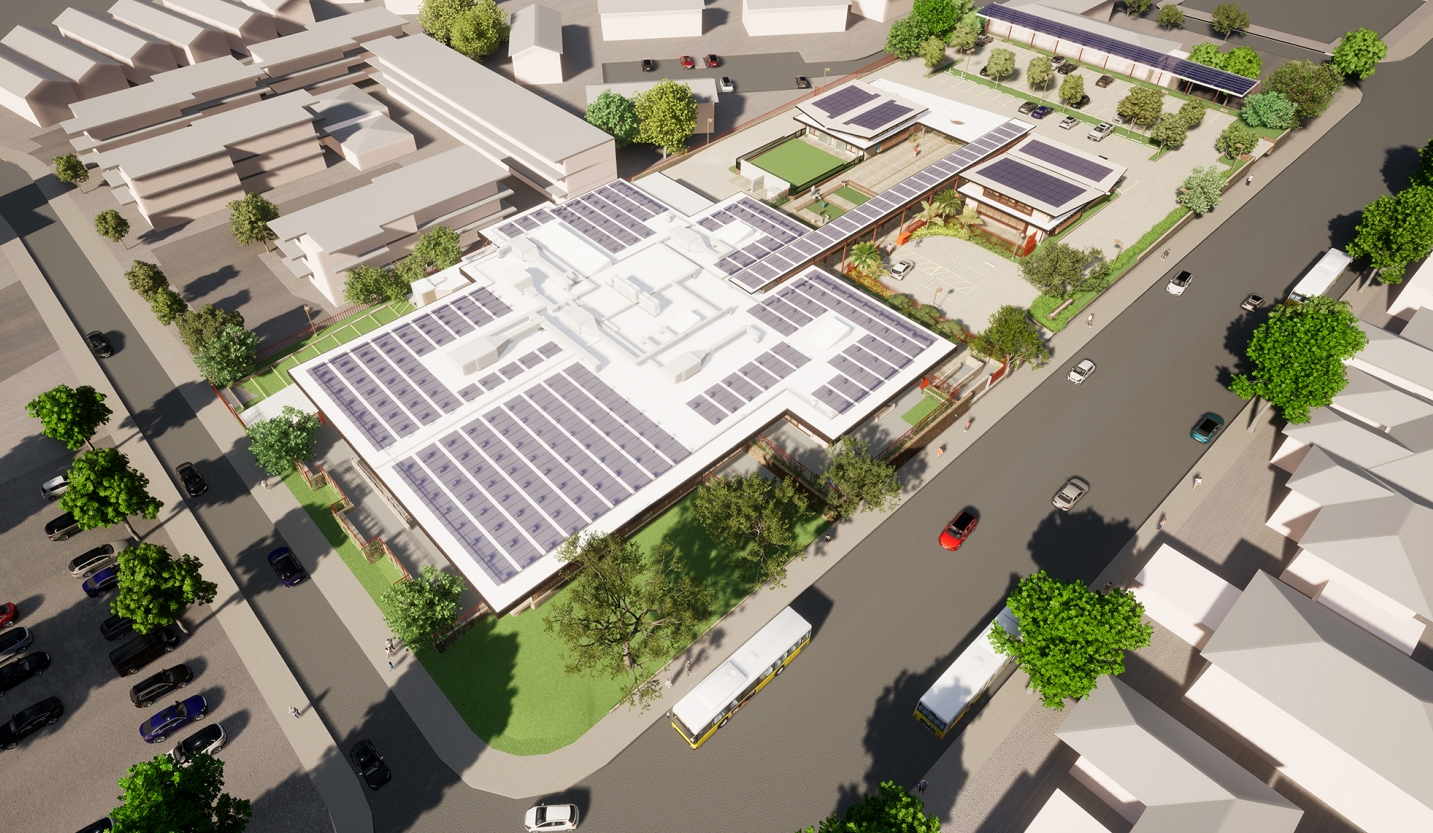
Leading by example, the state of Hawaiʻi has initiated a number of projects to retrofit and prioritize energy efficiency, including the Pearl City Public Library Renovation and Expansion by Dean Sakamoto Architects (DSA). As a comprehensive renovation of the existing Pearl City Regional Public Library (b. 1969), the project will expand the library grounds to better meet the evolving needs of the community. While improving the library building, DSA has designed a new campus that features a landscaped parking lot shaded by PV canopies and a unique 200-foot-long peristyle structure to form a monumental, covered walkway that connects the parking lot, new buildings, and courtyard with the main library entrance. The complex is designed to meet state of Hawai‘i sustainability law (LEED Silver or equivalent) and generate at least 80% of its operating energy from a new integrated PV system. Construction is expected to start in 2025.

Energy efficiency benchmarking projects initiated by the Hawaiʻi State Energy Office include high-level building energy audits and a multi-part energy strategy for utility bill cost savings for small and mediumsized state agencies. Developed in partnership with Hawaiʻi-based contractors, the strategy takes current technologies, incentives, tariff and grid options, energy costs, and financing approaches into account.

Participation in the National BPS Coalition will extend, update and strengthen existing policies for energy efficiency, such as Hawaiʻi’s Energy Efficiency Portfolio Standard (EEPS). “Net zero”- ready building energy codes can reduce embodied carbon in buildings and reduce “code fatigue” among developers. Building Performance Standards can guide the use of public funds that support energy efficiency retrofits for existing buildings.

“Joining the National BPS Coalition demonstrates Hawaiʻi’s commitment to clean energy, lowering energy costs and creating quality jobs,” said Governor Josh Green. “In partnership with the counties, building performance standards will keep us on track to achieve net zero emissions and realize our 2045 Energy Efficiency Portfolio Standard.”

“The National BPS Coalition directly addresses the need for lower energy costs, locally driven climate action and clean-energy workers hired from the local community. This effort provides local government with technical expertise and real-world case studies and connects residents with policymakers to make sure their needs are met,” said Alex Dews, CEO of the Institute for Market Transformation.

Together, the coalition’s members account for 25% of the nation’s large building space. If all members of the National BPS Coalition implement building performance policies, IMT estimates they will result in:

● Better buildings for over 90 million people

● $132 billion cumulatively invested in buildings through 2040

● 676 million metric tons of CO2e cumulatively eliminated through 2040

Video message from Governor Josh Green, M.D.

For more information about the coalition, visit www.nationalBPSCoalition.org

HAWAIʻI STATE ENERGY OFFICE RELEASES ALTERNATIVE FUELS, REPOWERING AND ENERGY TRANSITION STUDY

Study Recommends New Power Plant, Import of Liquified Natural Gas as a Bridge Fuel

HONOLULU — The Hawaiʻi State Energy Office has released a comprehensive Alternative Fuels, Repowering and Energy Transition Study that proposes an updated Hawai‘i energy transition strategy to improve electricity affordability and grid reliability, accelerate renewable energy adoption and support national security.

The study analyzes low-carbon fuels and repowering options to meet the state’s Renewable Portfolio Standard (RPS) targets and mitigate oil price volatility that is so damaging to Hawai’i’s economy in the aftermath of the Maui wildfires.

In this analysis, all alternative fuels were on the table. The fuels considered included methane/liquid natural gas (LNG), hydrogen, biomethane, biodiesel, e-methane, hydrogen, e-ammonia, e-diesel and e-methanol. HSEO and third-party consultants developed an evaluation matrix that served as a decision making framework to compare alternative fuels based on technological maturity and commercial viability, cost-effectiveness and lifecycle carbon intensity.

“Viable pathways exist that allow for the rapid replacement of costly and carbon intensive residual oil, offering cost savings to ratepayers while strictly adhering to our RPS targets,” said Chief Energy Officer Mark Glick. “The addition of highly efficient power generation and bridge fuels like natural gas can save money while the state transitions to the most viable firm renewable energy options as they become
economical.”

Mitigating Liability Risk and Addressing Power Plant Reliability

In recent months, Hawaiian Electric has taken significant actions to reduce uncertainty around its financial situation and the impact of wildfire litigation on customers. However, the downrating of Hawaiian Electric’s credit rating after the tragedy has increased the cost of debt financing for the utility and independent power producers, challenging the financing of future renewable energy projects and necessary capital expenditures to continue moving the energy transition forward.

Key Findings
The results of HSEO’s evaluation of fuels and power plant upgrades based on the criteria of technological maturity, commercial viability, cost-effectiveness, and lifecycle carbon intensity are summarized below:

  • Land availability and other factors indicate that local energy supply is insufficient to meet both current and forecasted demand. Accordingly, some energy imports will persist for both the electric and transportation sectors even after Hawaiʻi satisfies the 100% RPS.
  • The current Hawaiian Electric grid and development plans have high carbon emissions primarily due to substantial reliance on Low-Sulfur Fuel Oil (LSFO) as well as powerplant inefficiency.
  • Planned thermal capacity projects are critical to ensure grid reliability and will provide some improved powerplant efficiency; however, HSEO asserts that proposed and current Stage 3 and Integrated Grid Plan (IGP) thermal projects will likely result in one of two outcomes: either (1) higher electricity prices if biofuels are available and the PUC approves their costs, or (2) continued reliance on liquid oil-based fossil fuels, such as LSFO or ultra-low sulfur diesel.
  • Power plants can be converted, and a new power plant can be built to run on natural gas supplied by a Floating Storage Regassification Unit (FSRU) and associated gas infrastructure.
  • LNG emerged as the near-term fuel with the potential to cost-effectively reduce the state’s greenhouse gas emissions during the transition to economywide decarbonization in 2045, but more analysis is needed to quantify a range of potential benefits and to identify how those benefits can be maximized to residents at the appropriate level of infrastructure buildout.
  • Policy guardrails will be necessary to ensure that lower carbon fuels, such as LNG, will enable economywide decarbonization by 2045, not distract from it. There is a narrow, but beneficial path for the inclusion of LNG in the energy portfolio. Its build-out should not allow for backsliding on the RPS.

    With the planned re-use of LNG infrastructure for a hydrogen transition in 2045, the study indicates the incremental levelized cost of energy will be reduced by between 2.1 percent and 14.6 percent with LNG acting as a potential hedge against oil price volatility until a fully renewable grid can be realized.

    The import of LNG, as an alternative to LSFO, could result in as much as 38% to 44% reduction in lifecycle carbon intensity when used in more efficient power plants. Natural gas can be used as a replacement for residual oil until it is phased out completely by 2045, as local production of biodiesel is accelerated and technology advances for the import of green ammonia and hydrogen.

    Next Steps

    HSEO has initiated a period of public outreach as legislators consider the consequences of maintaining the status quo or proceeding to further development and engineering design studies, integrating feedback from the community and utility stakeholders including Hawaiian Electric, Hawai’i Gas and Par Hawai’i.

    While HSEO’s findings suggest that using LNG on O‘ahu could lead to cost and carbon savings, the analysis depends on certain key assumptions and risks including acceptance by regulators and Hawaiian Electric, environmental review, permitting and aggressive project timelines.

    In releasing the study, the Chief Energy Officer emphasized that continued development of solar, wind, battery storage, and other renewable power generation sources must vigorously occur in tandem with a fuel transition to ensure Hawai‘i has a diverse energy portfolio. The new energy strategy can attract needed capital to strengthen grid reliability, stabilize costs, and increase affordability for Hawaiʻi ratepayers.

GOVERNOR GREEN SIGNS EXECUTIVE ORDER TO PROMOTE AND EXPEDITE RENEWABLE ENERGY, REDUCING ENERGY COSTS

HONOLULU — Governor Josh Green, M.D., today unveiled an executive order to promote and expedite the development of renewable energy in the state of Hawaiʻi.

In the face of federal uncertainty regarding renewable energy and concerns over grid stability across the state, the Governor is committed to expanding and accelerating Hawaiʻi’s renewable resource development, and has outlined priorities to reduce energy costs, prevent blackouts, and slash emissions for Hawaiʻi residents and businesses. 

The executive order, developed with the Hawaiʻi State Energy Office and the input of various energy stakeholders across the state over the last year, outlines new policy objectives and directives for the state of Hawaiʻi, including accelerating renewable development for neighbor island communities to hit 100% renewable portfolio standards from 2045 to 2035, setting a statewide goal of 50,000 distributed renewable energy installations (such as rooftop solar and battery systems) by 2030, and directing state departments to streamline and accelerate the permitting of renewable developments to reduce energy costs and project development timelines. 

In addition, the order calls upon the Hawaiʻi Public Utilities Commission and Hawaiian Electric Company for support in reducing redundancies and inefficiencies in energy permitting and to prioritize reduced energy costs and energy stability for Hawaiʻi’s people.  

“Hawaiʻi needs to take some drastic steps to reduce energy costs, which have continued to rise and have contributed to the high cost of living for our people,” said Governor Green. “We know that high energy costs in Hawaiʻi are due to our reliance on burning oil for electricity and old infrastructure, which is really unacceptable. We can and must do more to get this under control.”

Despite the federal administration signaling a turn away from renewables, Governor Green is doubling-down on a diversified, renewable-centered approach to cut costs and emissions.

“This EO represents the start of real action to lower costs, support a stable energy system, and reduce emissions,” said Chip Fletcher, the Governor’s climate advisor and interim dean of the School of Ocean and Earth Science and Technology (SOEST), University of Hawai‘i at Mānoa. “Governor Green is cutting the red tape to realize our shared energy goals, including the first-ever push to get neighbor island communities to energy independence a decade sooner.”

“The goal of 50,000 distributed renewable energy installations before 2030 demonstrates the state of Hawaiʻi’s commitment to ensuring more affordable and resilient energy for Hawaiʻi’s people,” said Rocky Mould, executive director of the Hawaiʻi Solar Energy Association. “We are excited to aggressively expand opportunities for rooftop solar and energy storage and unleash its power and promise for the clean/decarbonized grid of the future under Governor Green’s leadership.”

Energy costs have risen starkly in Hawaiʻi, which has the highest average residential energy rate of any state in the U.S. 

High electricity and utility costs impact households, are a drag on Hawaiʻi’s economy, and add additional tax burdens by increasing government operating expenses. Energy cost increases have represented a $15M recurring increase in the Governor’s latest biennium budget for the Department of Education’s operations alone.

A copy of the executed executive order can be found here.

HAWAIʻI TO RECEIVE $18M TO REDUCE ENERGY USE AND CARBON EMISSIONS FROM LARGE BUILDINGS

Update: April 7, 2025 — Pending release of federal funding.

HONOLULU, HI — The U.S. Department of Energy (DOE) has announced that Hawaiʻi is one of 19 state and local governments that will receive more than $240 million to adopt and implement the latest energy-efficient or innovative building codes. These improvements will help renters and commercial building operators save money on their utility bills. In Hawaiʻi, the funding will support the development and adoption of a Building Performance Standard (BPS) to improve the energy performance of the state’s largest commercial buildings (50,000 square feet and above) which currently account for approximately 80% of the state’s commercial electricity usage and about 78% of total commercial building emissions.

The expected outcomes of the Hawaiʻi BPS policy are an overall reduction in energy use and emissions from commercial buildings and lower operational energy costs for building owners and renters, with a commensurate increase in demand for good jobs in the skilled trades industry.

While tailored to increase energy efficiency in the commercial building sector, large high-rise multifamily buildings (100,000 square feet and above) will be eligible to apply in a second phase of the program.

A significant portion of the funding will be used to implement state and county capacity building and multi-year investments in skilled trades workforce development and education. Qualifying building types include hotels and resorts, food services, mercantile (strip malls), offices, education (schools), healthcare (outpatient) and warehouse and storage facilities. The implementation of the BPS is expected to create the demand for this clean energy workforce. In line with the Biden Administration’s Justice40 initiative, 40% of the grant funds will be allocated for a technical assistance program in low-and-moderate income communities and for the implementation of new trades apprenticeship and education programs.

“As Hawaiʻi continues to make strides in meeting its 100% renewable energy and decarbonization goals, it is critical that we continue to reduce our energy demand by being as energy efficient as possible. This policy will be key to our ability to meet our 2030 and 2045 goals,” said Hawaiʻi Chief Energy Officer Mark. B. Glick.

“Making our buildings more energy efficient will lower energy bills while also helping us fight the climate crisis,” said U.S. Senator Brian Schatz. “This new funding will help strengthen our workforce and enable people across Hawai‘i to reap the benefits of our transition to a cleaner future.”

The Hawaiʻi State Energy Office developed the proposal in partnership with the City of County of Honolulu’s Office of Climate Change, Sustainability and Resiliency, Kauaʻi County’s Office of Economic Development, Maui County’s Office of Economic Development, Hawaiʻi County’s Office of Sustainability, Climate, Equity, and Resilience, the University of Hawaiʻi at Mānoa’s School of Architecture and the Sea Grant College Program, as well as private sector consultants from both Hawaiʻi and other mainland states.

For a full list of projects, please click here. Selection for award negotiations is not a commitment by DOE to issue an award or provide funding. Before funding is issued, DOE and the applicants will undergo a negotiation process, and DOE may cancel negotiations and rescind the selection for any reason during that time.

2023/2024 HAWAI‘I GREEN BUSINESS AWARDS PROGRAM HONORS HAWAI‘I BUSINESSES AND EVENTS FOR SUSTAINABILITY PRACTICES 

HONOLULU, HI — The Hawai‘i Green Business Program (HGBP) recognized its largest-ever cohort of Hawai‘i businesses and events today for their energy efficiency and sustainable business practices.  

Governor Josh Green, M.D., praised awardees for their demonstrated commitment to conserving energy and water, reducing waste, and protecting Hawai‘i’s environment, saying: “Hawaiʻi will not forfeit its commitment to a more resilient, clean economy. We must change how we do business. And we must model for others what this change looks like. Devoting our energy (literally) to regeneration and renewal is what nature is inviting us to do.”

The 40 awardees representing five islands were recognized during the annual HGBP awards ceremony in the Governor’s Ceremonial Room in the State Capitol. The ceremony was hosted by the Hawai‘i State Energy Office, the Hawai‘i State Department of Health, the Honolulu Board of Water Supply, and the Hawai‘i Tourism Authority. 

Chief Energy Officer Mark Glick said: “Our constitutional kuleana to steward Hawai’i’s natural environment sets us apart as a leader in the energy transition. While energy efficiency may not be the most glamorous path forward, the results are clear – conservation saves people money and lowers carbon across the state.”

DBEDT Director James Kunane Tokioka added: “Today’s event is a key example of the public and private sectors coming together to move forward in our mission of creating a sustainable Hawai‘i together. The businesses, venues and events who support this mission are vital to our local economy and the importance cannot be understated.”

The honorees of this year’s Hawai‘i Green Business Program Awards are:

Green Hotels, Resorts, Venue and Office Awardees:

  • The Kahala Hotel & Resort
  • Hokulani Waikiki, a Hilton Grand Vacations Club
  • Hyatt Centric Waikiki Beach
  • Marriott’s Ko Olina Beach Club
  • Prince Waikiki
  • The Cliffs at Princeville
  • Four Seasons Resort Maui
  • Maui Bay Villas, a Hilton Grand Vacations Club
  • Kings’ Land, a Hilton Grand Vacations Club
  • Mauna Kea Beach Hotel
  • Westin Hapuna Beach Resort
  • Four Seasons Resort Lānaʻi
  • Sensei Lānaʻi, A Four Seasons Resort
  • Hawai‘i Convention Center
  • Waialae Country Club
  • Honeywell/Smart Energy

Green Event Awardees:

  • 2023 Hawai‘i Library Association/HASL Conference
  • 2024 Sony Open
  • Earth Day 2024 Hawai‘i Pacific University
  • Make a Splash Festival
  • Sentry 2023 Golf Tournament
  • Sunshower Weddings & Events

Entry Level Program Awardees:

  • Central Pacific Bank Earth Day
  • Banán
  • Pō‘ai by Pono Potions
  • Drip Studio
  • Aloha ‘Āina Juice Cafe
  • Collab Cafe
  • Fresh Bite
  • Kalalea Juice Hale
  • Kōloa Pizza Kitchen
  • Orly Patisserie
  • Niu Life Kitchen (Wailuku)
  • South Maui Fish Co. (Kihei)
  • Wailuku Coffee Co. (Wailuku)
  • Abundant Life Natural Foods
  • Hilo Coffee Mill
  • Holo Holo Charters
  • Journey to Good Health Cafe
  • Koana Coffee

For further information please visit Hawaii Green Business Program.

Images of the ceremony and recipients can be found at 6.28.24 Green Business Award Ceremony | Flickr.

GOVERNOR JOSH GREEN, M.D., CHIEF ENERGY OFFICER, MARK GLICK, UPDATE U.S. STATES’ ENERGY OFFICIALS ON HAWAIʻI’S ENERGY STRATEGY

HONOLULU – Governor Josh Green, M.D., joined Mark Glick, chief energy officer of the Hawai‘i State Energy Office (HSEO), at the Imin International Center today at a conference of the National Association of State Energy Officials (NASEO), updating western regional officials on Hawaiʻi’s energy priorities in the aftermath of Maui’s devastating wildfires.

“As the pioneering state for a 100% renewable portfolio standard, we are committed to eliminating our dependency on imported fossil fuels by 2045,” said the Governor.

Governor Green outlined the state’s near-term energy strategy addressing three C’s: Cost, Carbon and Capitalto lower costs, lower carbon and open access to capital to secure the viability of the state’s largest utility, as Hawaiʻi progresses toward its legislated mandate of net zero carbon by 2045.

“We are dealing with a new normal in the aftermath of the Maui wildfires,” said Glick, “but the challenges are not insurmountable. 

“Working with energy stakeholders throughout state and national partners like NASEO, we will maintain or accelerate Hawaiʻi’s transition to renewables, as we prioritize upgrades and replacements to thermal power generators that will continue to be predominantly relied upon over the next decade and a half to provide dispatchable power.”

A quantitative analysis undertaken by HSEO in Pathways to Decarbonization underscores the need to maintain development timelines for renewable energy projects statewide as the primary way to lower the carbon intensity of each island’s grid. In all scenarios, progressively reducing emissions from fossil fuel generators is the primary driver of emissions reductions.

Hawaiʻi’s transition to a lower cost, lower carbon economy by 2045 is aided by historic federal investments in climate–resilient infrastructure: $72.8 million in clean energy investments in 2024 with an additional $366 million in funding applications in progress, including funding for two critical customer hubs in Maui and $70 million in home electrification and appliance rebate programs for low-to-moderate income families.

HSEO will release the findings of a comprehensive fuels analysis in May.

# # #

HAWAI‘I STATE ENERGY OFFICE AND KAUA‘I ISLAND UTILITY COOPERATIVE RECEIVE FEDERAL SUPPORT FOR INNOVATIVE TECHNOLOGY DEMONSTRATION PROJECTS

Projects will boost reliability and support utility’s goal of reaching 100% renewable energy with in 10 years

LIHUE, Hawai‘i – The U.S. Department of Energy today announced two technology demonstration projects proposed by the Hawai‘i State Energy Office (HSEO) in partnership with Kaua‘i Island Utility Cooperative (KIUC) will receive more than $17.9 million in funding through the Grid Resilience and Innovation Partnerships (GRIP) Program. 

Both projects leverage existing power generation equipment with new technology to expand dispatchable renewable energy and support reliable island grid operation among other benefits. Together these solutions will enable KIUC to achieve its goal of 100% renewable energy within the next 10 years. 

“Kaua‘i is proving that transitioning to locally produced renewable energy alleviates the energy burden for families and businesses by reducing extreme price volatility,” said Governor Josh Green, M.D. “We are grateful to the Biden Administration for supporting these projects, which we believe will showcase how these technologies can achieve similar benefits on other islands.”  

“HSEO is excited to be working with KIUC to implement these innovative solutions to bring solar grid forming and synchronous condenser conversion technologies to Hawai‘i,” said Hawai‘i Chief Energy Officer Mark B. Glick. “These projects will provide significant community benefits by adding value to existing renewable resources, providing opportunities for additional renewables, reducing the frequency and impact of power disruptions, and further decarbonizing the grid by reducing fossil generation.” 

“At 60% renewable generation, KIUC’s transition has not only resulted in significant greenhouse gas reductions, it has also saved our members millions of dollars over the past few years through stabilized electricity rates that are no longer vulnerable to spikes in oil pricing,” said KIUC’s President and Chief Executive Officer, David Bissell. 

The projects are scheduled to begin in early 2024 with an estimated completion date in mid-2025.  

About the projects: 

The Utility Solar Grid Forming Technology (USGFT) and Synchronous Condenser Conversion Technology (SCCT) demonstration projects will be funded in part through the Grid Resilience and Innovation Partnerships (GRIP) Grid Innovation Program of the Grid Deployment Office, Office of Clean Energy Demonstrations.  

Utility Solar Grid Forming Technology  

The GRIP program will provide half of the total cost-shared project estimated at $32.5 million, with KIUC contributing the other half of the total project cost. 

The USFGT project involves an innovative technology application that demonstrates a technological solution for expanded renewables dispatch and reliable island grid operation. The project adds battery storage and advanced grid forming inverters to two existing solar power plants. This will create a hybrid power supply with enhanced dispatchability, greater resource availability, and will provide important ancillary services including frequency regulation, reactive power and voltage control, and operating reserves. The grid regulation service will provide significant regional and community benefit by furthering the capability of the system to accommodate 100% dispatch of renewable generation sources and provide a more reliable and resilient island grid. 

Click here to read the U.S. Department of Energy’s Grid Deployment Office fact sheet on the project. 

Synchronous Condenser Conversion Technology  

The GRIP program will provide half of the cost-shared project of $3.35 million, with KIUC contributing of the remaining half of the total project cost.  

This innovative project adds grid-forming capability to an existing generator at the Port Allen power station to accommodate stable operation of high penetration distributed variable renewable generation on the Kaua‘i electric grid. The project will provide significant regional and community benefits by reducing the likelihood and consequence of disruptive events to the grid, and provide a reference case for duplication of the conversion technology by others. This novel use of grid-forming technology in a grid of this size will demonstrate a replicable solution for local, regional, and interregional grid enhancement and decarbonization. 

Click here to read the U.S. Department of Energy’s Grid Deployment Office fact sheet on the project.   

The Kaua‘i projects and a previously announced award to Hawaiian Electric are among the recipients of the largest-ever investment in America’s energy grid announced today.

Click here to read the U.S. Department of Energy announcement of more than $3.5 billion in awards across 44 states.    

###

>